
The First Draft of the Three Faces of Fate is Code Complete
The first draft of “The Three Faces of Fate” is done! 103,000 words of action and dialogue, and characters including a martial artist, druid, hacker, and a demon. Read More …
Richard Parry: writer, liar, superhero
The first draft of “The Three Faces of Fate” is done! 103,000 words of action and dialogue, and characters including a martial artist, druid, hacker, and a demon. Read More …
In the Year of our Lord 2022, Microsoft cranked up the price of M365 Business Essentials. We switched to iCloud, dropping cost to 27% of Microsoft’s. Easy setup? Check. Increased email storage? Check. A few complications? Check. Let’s dig into the detail. Read More …
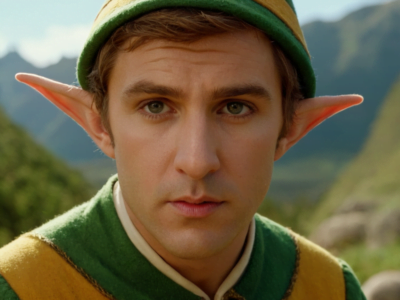
I’m going to use the Humane AI pin and Rabbit R1 as primary examples to emphasise a failure of imagination leading to innovation starvation in Big Tech™. My discussion extends to the failure of larger companies and their preference for safer, incremental upgrades. This scenario applies even to AI, where the potential for AI to dynamically enhance daily life remains largely untapped despite existing capabilities. Technology might integrate and expand human-like functionalities if it could blend daily observations with generative models. Read More …
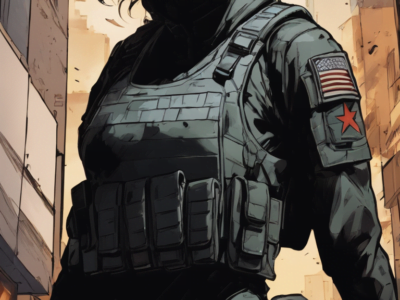
Where I talk with an AI on the likelihood of a US civil war, the causes and preventions, and whether there are wider issues at play. Read More …

AI innovations are expanding into creative areas without addressing urgent societal needs, sometimes creating solutions for non-existent problems with quality not yet matching human capability. A shift in tech financing questions the sustainability of free AI business models. There’s a critique of AI’s high energy consumption and inefficiency compared to the human brain, as well as concerns over misuse and regulation, particularly in the corporate sector where decision-making based on AI can lead to significant errors, exemplified by Air Canada’s blunder. Ultimately, the piece emphasises the need for AI to focus on solving challenging and painful tasks, providing real value, not trivialising creativity, and avoiding becoming a low-level tax on humanity. Read More …

Wayne, a Canadian ex-standup comedian turned writer, talks about his transition to authorship and his Werewolf PI Series set in urban landscapes like Chicago and Las Vegas. His characters navigate a world of supernatural beings, facing off against rival werewolves, occult dangers, and a multitude of paranormal threats. With two books out and a third releasing May 2024, he shares advice on writing and editing, while admitting fiction’s challenges. Wayne can be found online through his Amazon author page and social media. Read More …

After testing engagement on social media platforms through an experiment involving a post on Dragon’s Dogma 2, the author found Threads and Bluesky had minimal interaction while Reddit generated significant discussion. The results suggest that success on Threads and Bluesky is contingent on follower counts, which necessitates a substantial time investment, while Reddit rewards active engagement. The author plans to reduce efforts on the former platforms due to the lower engagement received. Read More …

Dan Brown published his The Da Vinci Code in 2003. Many people found it a thrilling page-turner. Fast-paced plot? Yep. Code-breaking puzzles? You bet. Art, religion, and conspiracy? In there too. It became a best-seller, spawning a Hollywood adaptation starring Tom Hanks. In 1965, Frank Herbert published Dune. It was arguably both groundbreaking and intricate, with McMassive world-building, political intrigue, and (well before we woke up to the need) eco-warrior themes. It’s regarded as a classic, also cranking out a (fucken superb) Hollywood adaptation (in three parts, two of which we’re still waiting for, Denis!). Blade Runner, one of my all-time favourite cyberpunk movies, and arguably what started me on the path to write Chromed: Upgrade, hit the streets in 1982. It’s a Ridley Scott masterpiece, with deeply thought-provoking and often disturbing themes, dystopian atmosphere, and (lest we forget) Harrison Read More …

Without wanting to be a Debbie Downer on your recent-and-hopefully-delightful vacation, many of you are facing a cost of living crisis. I had a reader email me and say (I paraphrase), “I’m not going to start reading your Tyche series because it’s just so many books and I can’t afford that.” Ignoring the inherent logical pitfall here (where, if you’re going to pay for something, there’s no pro or con to standalone vs. series – i.e., the price is the same for either a) a trilogy or b) three standalones), it does shine a light on where people are at emotionally. People are feeling fairly fucked by the economy. There may be a way to survive 2024 with more of your dollars intact, though. Ownership can create an emotional attachment and increase the perceived value of something (the endowment effect). Read More …
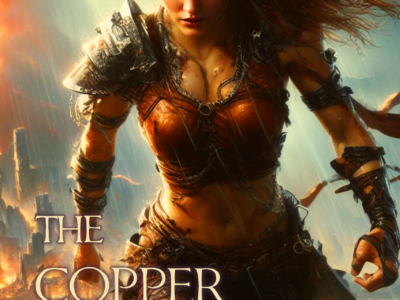
Evanne, meet the world. World? Here’s Evanne. Oh, when’s the book out? I’m charting for … January. I’m praying for my editor’s overload release valve. This was sent out to my mailing list before public release. If you’re interested in earlier access to insider information, consider subscribing!